Folio CV
A free, private CV builder that runs entirely in the browser.
Problem
Most free CV builders ask for an account, store your CV on their servers, or lock the PDF export behind a paywall. Many also use multi-column layouts that applicant tracking systems (ATS) read badly.
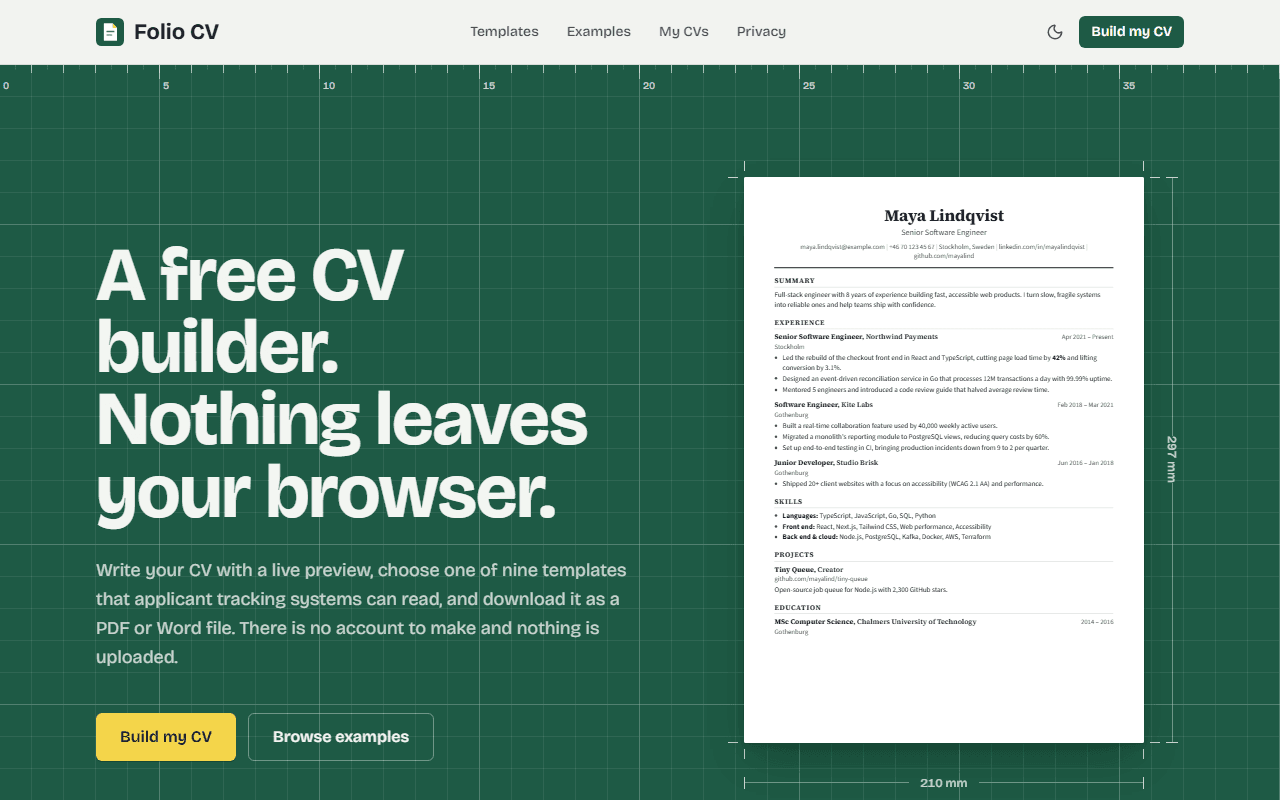
Folio CV is a CV builder with none of that: no sign-up, no server and no upload. You open the builder and start typing.
My role
I designed and built Folio CV on my own: the design system and landing page, the editor, the templates, the export pipeline, the ATS check and the CI.
Constraints
- No server, by choice. Everything had to work in the browser and deploy as static files.
- A size budget. The landing page had to stay under 150 KB of gzipped JavaScript.
- Accessibility. The target was WCAG 2.1 AA.
- Time. I built it in eight milestones over three days.
Process
No server at all. The site is a static export of Next.js 16, with no API routes, Server Actions, middleware or database. CVs are saved in the browser's IndexedDB and never leave the device. JSON backups move a CV to another device.
One versioned document. A CV keeps its content, its template and its design (fonts, colour, spacing, paper) apart. Every read from IndexedDB and every import goes through a migration step and then zod validation, so CVs saved by older versions keep loading.
A PDF that matches the preview. Each template is a React component sized in
real units. The same component drives the live preview, the example pages and
the export. To build the PDF, the app renders the template offscreen, reads
where the browser placed every line, rule and link, and draws exactly that with
pdf-lib, embedding the fonts. The text in the PDF is real and selectable,
which is what an ATS needs. Word and plain-text exports use the same render
model.
An ATS check you can act on. A pure function checks contact details, section headings, bullet length, dates, page count and layout. Each issue links to the field that causes it, and the panel says plainly that the rules are guidance, not a guarantee.
Small by default. The editor, drag and drop, the export libraries and the check panel load only when someone uses them.
Outcome
- Live at folio-cv-theta.vercel.app (opens in a new tab), with nine templates. Only one uses two columns, and it is labelled "less ATS-safe".
- Exports to PDF, Word (
.docx), plain text and JSON backup. - CI runs type checks, lint, formatting, unit tests, the build and a bundle budget on every push. The build fails if the landing page goes over 150 KB of gzipped JavaScript.
- Built to WCAG 2.1 AA and checked with axe-core and keyboard walkthroughs.
- The site sets no cookies and makes no third-party requests.
What I'd do differently
I'd plan for scripts beyond the Latin alphabet from the start. The PDF export embeds static fonts, so a CV with Arabic text or emoji can't be downloaded directly. The export falls back to the browser's print dialog.
Technologies used
- TypeScript
- Next.js
- React
- Tailwind CSS
- Zustand
- Zod