Vertex
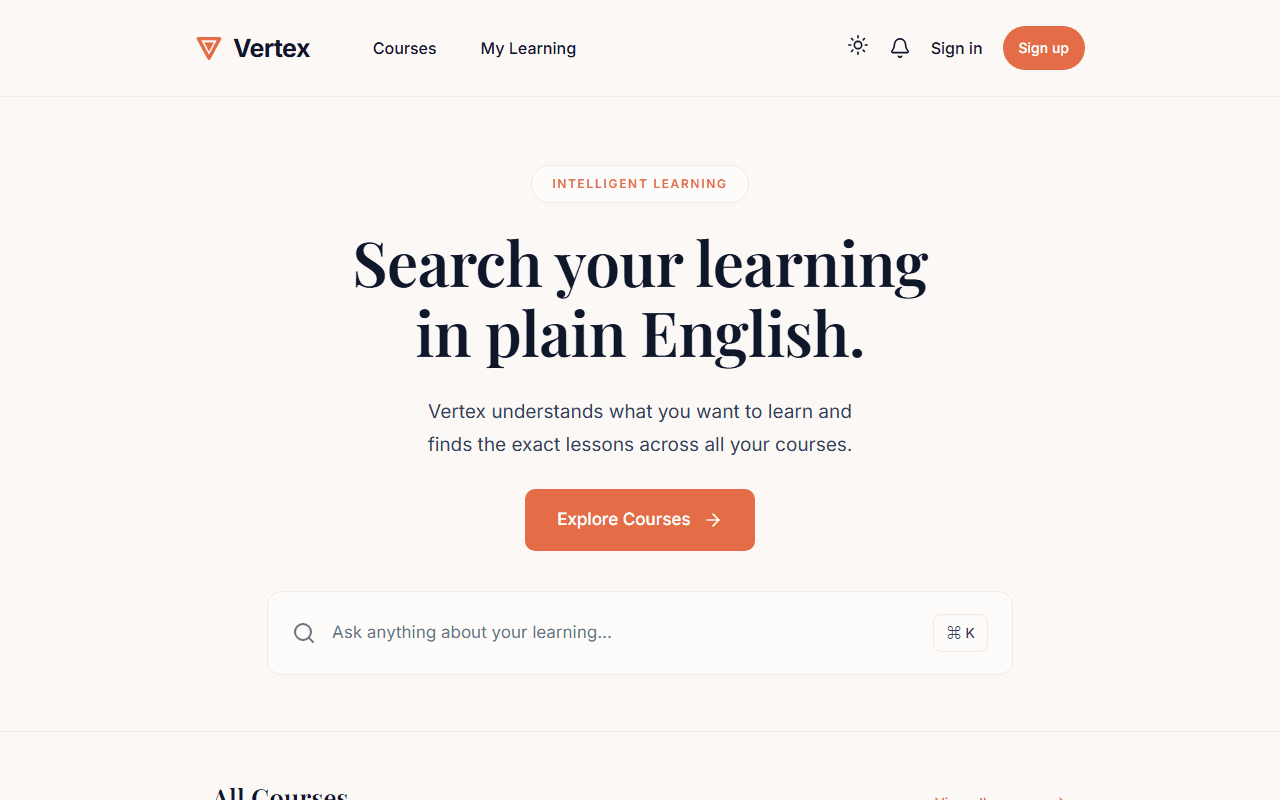
A learning platform with plain-language search that jumps to the exact second a topic is taught.
Problem
Video courses are hard to search. When a learner wants to revisit one idea, they have to remember which lesson covered it and scrub through the video to find the moment.
Vertex lets a learner type a question in plain language and get back ranked cards. Each card links to the exact second in a lesson's video where that topic is taught, and the video plays on the site.
My role
I built Vertex on my own: the Sanity content model and Studio, the Next.js site, the search pipeline, the video ingestion scripts and the Vercel deployment. Every change went through a pull request with automated review from CodeRabbit.
Constraints
- Time. The first full version, from the first commit to the deployed site, took five days.
- A function time limit. Search runs several model calls in a row, and all of them have to finish inside one serverless function's time limit.
- A free model. Search first ran on a free-tier model, which was slow.
- Secrets stay on the server. The browser only ever posts to
/api/search. It never sees the model key, the search endpoint or the Sanity tokens.
Process
Authors create and manage courses in Sanity, and a Next.js site serves them to learners. Search is built with the AI SDK, and Clerk handles sign-in.
Search writes its own queries. /api/search connects to Sanity's Context
MCP server, gives the model the deployed schema and a system prompt, and lets
it write GROQ queries over the catalog. After a few round trips, a final step
returns structured results. Zod validates them, so only results grounded in
what the queries returned reach the page.
Transcripts are prepared ahead of time. Offline scripts fetch each video's captions with yt-dlp and store the transcript as short timestamped chunks. A hand-written chapter list gives every video a table of contents, so search matches chapters first and falls back to the noisier transcript only when it has to. Whole transcripts never reach the model.
Results open at the right second. A video result links to the lesson page with a start time, and the player passes it to the video provider's embed. The video plays on the site, starting at that moment.
Progress is saved for each learner. When a lesson's video ends, the lesson is marked complete. A My Learning page lists started courses and resumes each one at the last second watched.
Outcome
Live at vertex-iota-ashy.vercel.app (opens in a new tab).
- Ten sample courses in Sanity, with course, lesson, search and My Learning pages.
- Search now runs on a Gemini model, after the free-tier model proved too slow for its chain of calls.
What I'd do differently
I'd test the model's speed before building search around it. The free-tier model took about 13 seconds for a trivial reply, and search makes several calls, so it timed out both locally and in production.
I'd also set the function's time limit from a measured slow query, not a guess. My first limit was 60 seconds, below search's own 90-second deadline. The platform cut slow searches off first, and learners got a bare error the search page couldn't show.
Technologies used
- TypeScript
- Next.js
- Sanity
- Tailwind CSS
- AI SDK
- Clerk